A silver lining is described as a positive aspect that emerges from a challenging situation. “There’s a silver lining to every cloud” is a phrase you may have heard or even repeated. It reminds us that “glimmers”, or micro-moments of (perhaps) joy, happy feelings, hope, insight (etc.) can be noticed.
Glimmers is a term coined by licensed social worker and trauma expert Deb Dana. It refers to the idea that, while the brain is evolutionarily wired to scan for threats/triggers, actively looking for the glimmers builds our emotional resilience and soothes the nervous system.
That sounds good! Let’s resolve to relishing the glimmers more.
Here’s one of ours: YogaCaps is participating in the NH Union Leader’s “Silver Linings” expos in various locations in the state. The event provides a forum for older adults to meet the often layered needs of life in an aging body.
At this year’s inaugural event in Nashua, YogaCaps’ President, Jay Gupta, RPh, 340B ACE, MTM Specialist, C-IAYT spoke about the “Perils of Polypharmacy”. This is an especially important topic for all older adults, especially those who take (or care for others who take) multiple prescription drugs along with supplements, herbals, vitamins and other remedies.
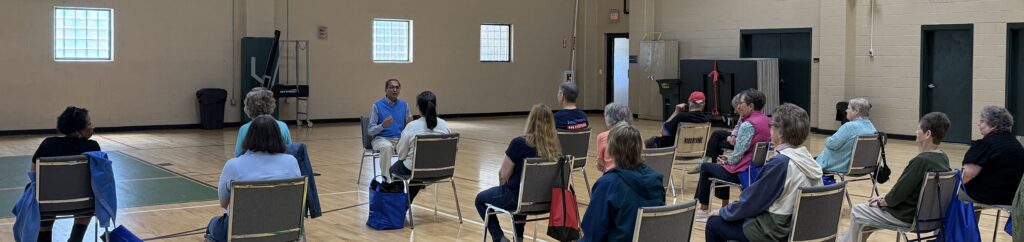
Let’s take a live peek into Jay’s session at the event…

Jay asks: how many in the group have ever heard the word “polypharmacy”. A mere 10% of the hands rise up… and some are hesitant and seem unsure if it really does sound familiar. Someday, he intends, it will be 100%. He proceeds to share the definition of polypharmacy and delves into it’s rapid escalation, as well as the risks that are often experienced and multiplied with each added medication.
Citing the research, and his own work as a pharmacist and medication therapy management specialist of over three decades, he informs the group that nearly 50% of older adults take one or more pharmaceuticals that are not medically necessary any longer. Long-ish pause.
With permission, he shares Jim’s compelling story. Jim is a person that he once provided medication counseling to. Jim could not recall why he is taking the round, unassuming light blue tablet that seems to have been hiding amongst his daily cocktail of pills. His medication records indicate that he has been taking this 10mg moderate-to-strong dose of diazepam twice per day… for the past 20 years.
After they work together to reconstruct what was happening in his life back then, Jim has a recollection of the initial prescription from when he was 60 years young and grieving his father’s death. “Medications can be helpful and necessary”, Jay says, “but we can and should watch for if and when they might be considered for ‘de-Prescription’ and have the discussion with your prescriber before any changes”.
De-Prescription may involve actions like altering, exchanging, tapering, or eventually eliminating a medication. Emerging networks of health professionals, led by pharmacists like Jay, tell us that it involves various protocols, mathematical calculations, close guidance and continued communication between the prescriber and person taking the medication.
Is it worth it? Well, Jay counsels Jim that diazepam is on the American Geriatrics Society Beers Criteria list of potentially inappropriate medications for older adults (65 and older). He further shares that long-acting drugs like diazepam, can lead to drug accumulation, excessive sedation, and significantly increased risks of confusion, delirium, falls, and fractures. All are a looming cloud of extremely challenging situations. He also ensures that the prescriber and Jim will work together to quickly address this.
This is certainly a shimmering silver lining in the raging storm cloud that is polypharmacy.
Jay closes the polypharmacy talk with six practical interventions to help reduce polypharmacy and the related risks. These six silver linings provide potentially life saving education. While none of the strategies are intended as medical advice; each person is invited to discuss them with their healthcare team.
He then transitions down the hall and into his next session, a seated therapeutic yoga class with a falls prevention focus. He greets the group and acknowledges some of the same faces from the prior session on polypharmacy.
Of course, there is a connection between the two sessions. Wink. Wink. Seated therapeutic yoga fits into one of the strategies to help mitigate polypharmacy. As reflected in the name of our nonprofit, “YogaCaps” (short for Yoga Capsules), there is growing scientific evidence that yoga can act in similar ways as some medicines. Many of us are already taking/practicing it regularly!
Yes, a great many more glimmers.
From our space in the YogaCaps educational booth, we see and hear so many older adults sharing resources with each other from the various tables that they have visited during the expo.
They co-create a wisdom community of silver linings that will grow and glow on after this event ends.

We’re so encouraged that seated therapeutic yoga and polypharmacy education will be woven into this wisdom community!
You might be wondering about those six strategies that may help reduce polypharmacy and its risks? If you live in or will be visiting NH, you can attend the free sessions at one of the upcoming “Silver Linings” events on Saturday, August 15th in Exeter, NH, or in Manchester, NH on October 24th. Feel free to read, ask your health team and engage with us about this important info if you are not local, or not able to attend.
And finally, silver linings can be found just about everywhere, especially in gratitude…
Many thanks to Billy Wilson, the NH Union Leader team and all of the the service/product providers for dedicating their care, expertise, resources and time to support the comprehensive health and well-being of our older adults.
We also appreciate John Szyszlo, YogaCaps volunteer, who helped managed the exhibition booth while simultaneously capturing professional event photography.
And, we honor older adults everywhere for embodying a vital role as resilient silver linings of our communities.